
Identify Who Owns a Wallace County Property
Wallace County publishes no verified owner-search screen. The dependable route is a specific request to the office that keeps each part of the property record. Gather every identifier you already have. A street address often works for lots in Sharon Springs or Wallace. Rural acreage can be harder to pin down. A parcel number, account number, or section-township-range description may identify the land faster than an address would.
- Ask the Wallace County Appraiser for the parcel card and its owner-of-record field, supplying the address and legal description when possible.
- Use the parcel number and legal description to locate the newest conveyance through the Wallace County Register of Deeds.
- Compare the Appraiser name with the grantee on that deed. A recent filing may be newer than the assessment roll.
- If the grantee is a company, search its exact name or Kansas business ID in the Kansas Business Entity Search, without assuming the resident agent personally owns the land.
A solid answer to "who owns this property" rests on two government records. The records must agree, not just a lone unverified name. The deed shows the recorded conveyance. The parcel card ties that name to the tax and appraisal account. The official Wallace County Appraiser page opens the office route. It covers the first of those two records.
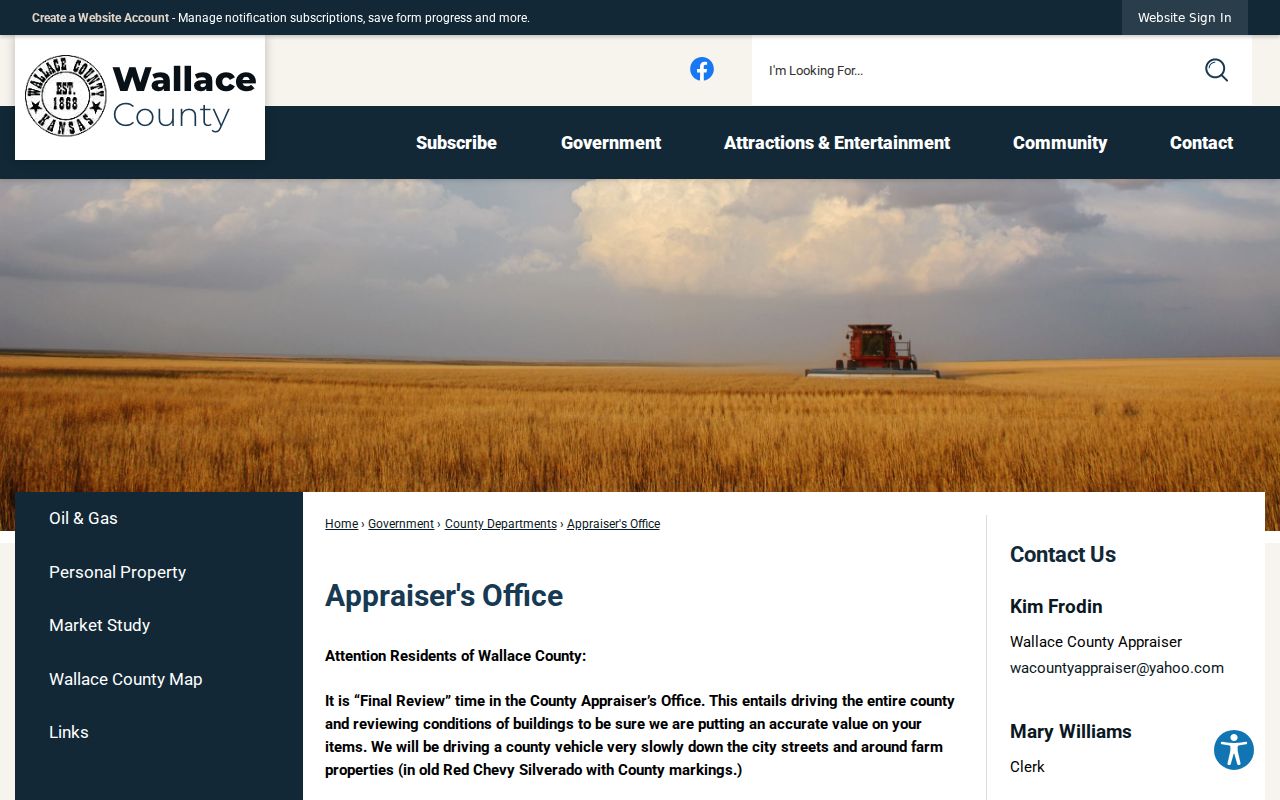
The Appraiser's own page lists duties and contact details. It offers no public owner-name search screen, so requests go through the office.
Request Wallace County's Exact Owner Field
The Appraiser describes appraisal duties and office contact information. It offers no public CAMA search you can run yourself. So ask for an existing parcel or value record. Do not ask staff to build a new report. Give the situs address, any owner-name variants, a parcel or account number, and the legal description. Also give the tax year. Keep the identifiers limited to what distinguishes the tract. Fewer details mean fewer chances for a mismatch.
Owner of record: the name carried on an official roll or instrument. Situs: the property's physical location. Mailing address: where notices are sent. Grantee: the party receiving an interest under a deed. These terms carry distinct meanings, so use each one precisely when you request records.
Do not treat mailing and situs addresses as the same thing. An owner may get notices somewhere else entirely. The mailing line proves nothing about who occupies the property.
Trace the Appraiser Name to the Latest Deed
Wallace County publishes no online deed-index interface. The Register of Deeds still keeps deeds, mortgages, oil-and-gas leases, affidavits, powers of attorney, and other instruments open for inspection during regular business hours, except protected records. The office sits at 313 N Main in Sharon Springs. Call 785-995-4281 ext. 330, email wadeeds@wallacecountyks.gov, stop at the counter, or file the county's open-records request form.
Request the newest deed indexed to the apparent owner. Then check its legal description against the parcel. Names collide more often than you would guess. The deed records page covers copy and index mechanics, but this ownership route needs only the latest relevant conveyance.
Note: A recorded grantee matched to a legal description beats a loose address or same-name hit.
Use the Clerk's Transfer Book as a Bridge
The Wallace County Clerk's duties tie the ownership trail together across transfer books, deed certifications, estate real-estate transfers, tax-roll adjustments, and severed mineral interests. That range makes the Clerk a valuable cross-check. It helps whenever the latest deed, the parcel card, and the tax-roll name disagree. A tangled chain of title may call for querying the Clerk and the Register of Deeds in parallel. This matters most where an estate or a severed mineral interest sits in the background.
Remember that this bridge is not a deed. It simply explains why one office's administrative record can lag behind. The lag shows up when another office has already recorded the instrument.
Read Trust, Estate, and Entity Ownership Carefully
A roll may name a trust, an estate, or an LLC rather than a person. Copy the exact punctuation and name variants into every request. For a Kansas entity, the Secretary of State search takes a business name, Kansas business ID, or resident agent. It returns only the first 200 matches. The agent is a contact point, not proof of who truly benefits from the entity.
Estate transfers can demand a district-court or probate cross-check. Wallace County sits in the 15th Judicial District. Public case information may appear through the Kansas courts portal or a courthouse terminal, subject to sealed and nonpublic limits. Use the case only to understand how the transfer moved. Then return to the recorded deed and its legal description for the ownership answer.
Where Wallace County Ownership Is Recorded
Each official source answers a narrower question. Combine them. That habit keeps a convenient tax-roll label from hardening into an unsupported claim about title or occupancy.
| Source | Owner Info It Gives | Access |
|---|---|---|
| County Appraiser record | Owner field, mailing address, parcel and value context | Request from the Appraiser; no verified public owner portal |
| Register of Deeds index | Latest deed's grantee and recorded legal description | Office inspection, phone/email inquiry, or KORA form |
| County Clerk transfer book | Transfer and estate cross-checks, tax-roll changes | Contact the County Clerk |
| Kansas Secretary of State | Entity status and current resident agent | Free online business search |
| ORKA/Kansas GIS | Parcel-location context and adjacent geographic layers | State viewer; Wallace owner linkage was not verified |
The ORKA entry page helps with orientation. The county's static map supplies broader context, not a parcel-owner index. Always carry the parcel number or legal description from the map into the office record before drawing conclusions.
A Wallace Name Alert Watches New Filings
The Register of Deeds promotes a free Property Fraud Alert that watches names used in recording activity. It can send email, text, or telephone notice. It cannot stop a fraudulent document. It cannot decide who owns land. What it offers is an early signal. An enrolled person can contact the Register of Deeds and law enforcement quickly. Enroll only through the official Wallace County office or the linked county service. The county describes the alert as free. Treat any unsolicited payment demand as a red flag.
Protected Addresses Change What a Lookup Shows
Some owners in Kansas cannot list a home address safely. The Safe at Home program gives eligible victims a substitute address. State and local agencies must accept it. When that address appears in a deed or tax roll, it is lawful for correspondence. It is not where the person lives. KORA adds another layer here. Custodians may redact protected material and may require a sworn lawful-use certification before releasing records.
Getting a listing scrubbed from a commercial site accomplishes nothing on its own. The source deed, roll, or court record still exists with its custodian. Corrections and protection requests belong at the originating office, not the aggregator. Keep that distinction in mind whenever public owner information matters.
Note: Treat any mailing line as a correspondence address unless an official record proves otherwise.
Match Rural Wallace Land Without a Strong Address
Rural Wallace County spans 913.65 square miles. Its population density sits at just 1.7 people per square mile. At that scale, a road or postal address is a weak key. It fails as a reliable anchor for an ownership search. A parcel number does far better work. Ask the Appraiser to cross-reference the situs against the parcel or account number. The office can also match it to the section-township-range description. For a platted town parcel, lean on the subdivision, lot, and block instead.
Aggregate figures mislead when stretched too far. The countywide owner-occupied housing rate is context only. It cannot show that a named owner lives on a specific parcel. The Census roster lists Sharon Springs and Wallace as incorporated places. Weskan, by contrast, is only a census-designated place. A postal locality proves neither municipal limits nor ownership.
Older tools help when the modern identifier stays unclear. The 1908 Standard Atlas township maps can turn up a historical name. So can the federal tract books tied to a land location. Take that lead back to the Register of Deeds and follow the recorded chain. An atlas label or land entry only points you somewhere to search. The matching recorded conveyances are what connect the person to later ownership. Keep identity, geography, and title evidence separate. That discipline makes any answer to who owns this property far more defensible.
What a Wallace County Ownership Lookup Cannot Prove
A name from the Appraiser has limits. It does not prove the person lives at the situs. It does not prove they hold every interest. It does not prove they still own the parcel after an unprocessed transfer. A GIS outline is not a boundary determination. Even a recorded deed, while strong evidence in the chain, is not a title opinion. Easements, severed minerals, probate orders, liens, and name variations can all complicate the true answer.
Lawful use. Use Wallace County owner information for legitimate property research, purchase due diligence, estate work, or boundary questions. Never use it to stalk, threaten, intimidate, or harass another person.
K.S.A. 45-230 also bars pulling names or addresses from public records for commercial solicitation, subject to statutory exceptions. Where a real decision rides on ownership, lean on the custodian's records and qualified title professionals rather than a directory result.