
What Wallace County Deed Records Preserve
A deed captures a transfer offered for recording, naming the parties and tying them together through the legal description. The Wallace County Register of Deeds keeps deeds together with mortgages, leases, powers of attorney, cemetery deeds, death certificates and affidavits. Kansas recording law decides whether an instrument qualifies. Recording alone, though, settles nothing about title.
| Deed Type | What It Does | Common Use |
|---|---|---|
| Warranty deed | Conveys the described interest with stated title covenants | Ordinary arm's-length conveyances |
| Quitclaim deed | Conveys whatever interest the grantor holds without broad warranties | Family transfers, corrections and title cleanup |
| Trustee or fiduciary deed | Transfers property through an authorized trust or estate representative | Trust administration and estate matters |
| Sheriff's or tax deed | Documents a transfer arising from a statutory or court process | Foreclosure and delinquent-tax proceedings |
| Mineral deed | Separates or conveys a mineral interest from surface ownership | Rural land and oil-and-gas title research |
Mortgages, liens and easements burden an interest rather than pass the whole estate. Give releases, satisfactions, assignments and corrections the same care as the deed itself. A later release can strip an old mortgage of effect, while a reserved mineral interest can outlast several surface transfers in the property records.
The Office Search Is the Wallace County Index
The county publishes no browser-based grantor-grantee index, and it states no coverage years or imaging cutoff. That gap is not proof a deed is missing. Contact the Register of Deeds at 313 N Main in Sharon Springs. Call 785-995-4281 ext. 330 or email wadeeds@wallacecountyks.gov. The Kansas Open Records Act keeps these records open during regular business hours, apart from statutory exclusions.
| Search detail to supply | Why it narrows the deed records |
|---|---|
| Grantor and grantee names, including variants | Separates incoming from outgoing transfers and catches initials or entity spellings |
| Legal description | Ties a name result to the correct tract, lot or block |
| Instrument type and date range | Limits the review to deeds, releases, easements, leases or other requested records |
| Book/page or instrument reference | Lets staff retrieve a known document directly |
Ask whether older entries demand a manual index or a deed-book review. The office publishes no earliest electronic year, so treat any claimed online cutoff with doubt.
Note: A broad request may require more staff time; owner variants, dates and a full legal description make the request identifiable.
Email, Mail, Fax and Counter Requests
The county's Register of Deeds open-records form requests contact details, a description of the information, a delivery choice, a signature and a date. Delivery runs by email, USPS, fax or pickup. Kansas law allows a written request without mandating any one form, and the agency may require advance payment of authorized costs.
Use the live office page for current contact details. An older PDF lists outdated phone and email information, while the current page names Margaret Figurilli as Registrar, Jenny Kuhlman as Deputy and the ext. 330 contact. Confirm hours before traveling for an in-person search. The nearby County Clerk keeps transfer-book and deed-certification entries. That office works as a cross-check when an estate transfer or a tax-roll correction muddies the trail.
Kansas Recording Fees Shape Copy Questions
K.S.A. 28-115 sets a $17 base charge for the first page of a deed, mortgage or other instrument. The rate is $13 per additional page under the current schedule, plus applicable statutory components. The statute also lists $32 per town-plat page. It charges $16 for a mortgage release or assignment, and $13 for a certification.
These are recording-schedule numbers, not a promise of what a plain or certified copy costs. Ask the office for a quote separating inspection, staff research, an ordinary reproduction and a certified copy. Delivery matters too. Postage or special handling can change the total.
Follow Wallace County Grantors and Grantees
Walk a deed chain backward. Begin with the newest reliable owner and hold the same legal description throughout. Because the Wallace County index stays office-held, phrase your request as a chain walk rather than asking staff to decide title.
- Obtain the current owner and complete legal description from the Appraiser or the newest known deed.
- Locate the deed into that owner, who should appear as grantee, and record its grantor and reference.
- Search that grantor as an earlier grantee, then repeat the process one transfer at a time.
- Compare acreage, lot and block, reservations, corrections and easements at every link; ask for older index volumes when needed.
- Grantor
- The party transferring the stated interest.
- Grantee
- The party receiving that interest.
- Chain of title
- The linked sequence of instruments affecting the same legal description.
- Book/page or instrument number
- A retrieval reference; ask which convention applies to the requested record.
Names shift over time. A simple surname chain rarely tells the whole story in Wallace County. Estate orders, trusts, and entity changes all interrupt the grantor-grantee line. The County Clerk's duties cover estate real-estate transfers and severed-mineral records. So those filings are a natural stop when a deed trail goes cold. A related probate or quiet-title case, though, may send you to the District Court instead.
Surface Deeds May Not Carry Every Mineral Right
Rural Wallace County land often splits surface ownership from severed minerals. Search mineral deeds, reservations, oil-and-gas leases, assignments and releases under both party names and the legal description. The Register of Deeds records the oil-and-gas instruments. The County Clerk expressly maintains the severed-mineral information. Parallel requests keep a surface deed from standing in for the entire property interest.
Easements and rights-of-way can likewise outlive the named owners. Read the referenced instruments rather than trusting a short index label. Check later releases or relocations too. Cemetery deeds count among the Register's recorded instruments. Some transfers fall within statutory sale-validation exceptions.
The Sale-Price Form Is Not a Deed Record
Kansas's Sales Validation Questionnaire gathers sale price, sale date and financing. It also notes unusual circumstances for covered transfers. Yet K.S.A. 79-1437c keeps the questionnaire unrecorded and destroys it after five years. Related law restricts access. Nobody can request it like an open deed image.
A deed may carry nominal consideration language or cite an exception. It may do so without revealing the deal's full economics. For value work, use the Appraiser's public valuation record and statutory summaries. That Wallace County quirk matters most when a recorded instrument shows no price at all.
A 1908 Atlas Can Start an Older Chain
Older chains of title need older maps. The 1908 Standard Atlas of Wallace County holds 42 digitized images, among them township landowner maps, town plats, and a patrons' directory. A street address means little on the prairie. The atlas can hand you an earlier owner name or a geographic clue where a modern address fails. Translate the location into section, township and range first. Remember what the atlas is not. It is a historical lead, not a deed, a current parcel map, or proof of title. For county materials on microfilm, the Kansas Historical Society's county-record guide lists holdings and interlibrary loan options. Confirm Wallace reel years before relying on a trip.
Free Name Monitoring Adds an Early Warning
The Register of Deeds offers a free alert service. Property Fraud Alert can send email, text, or phone notices whenever a registered name appears in a new recording. It is only a monitoring aid. Enrollment does not stop a filing. A flagged document is not automatically fraudulent either, so register the name forms most likely to appear, including an entity or trust name where relevant. An unfamiliar notice deserves a close look. Compare the instrument number, parties, and legal description against the genuine parcel before acting, then contact the Register of Deeds through its official page. The alert complements a periodic deed-record review but never replaces professional title work.
Order the Wallace County Deed You Identified
A book/page or instrument reference ends the index step. Say what you need from the start. Inspection, an ordinary copy, and certification are different requests. Order by email, USPS, fax, or pickup using the county form, or work at the counter during confirmed hours. Give staff every identifier you have. Parties, document type, date, and exact legal description help them separate similarly named people and tracts. Check the Register of Deeds page for current office details and access notices before ordering.
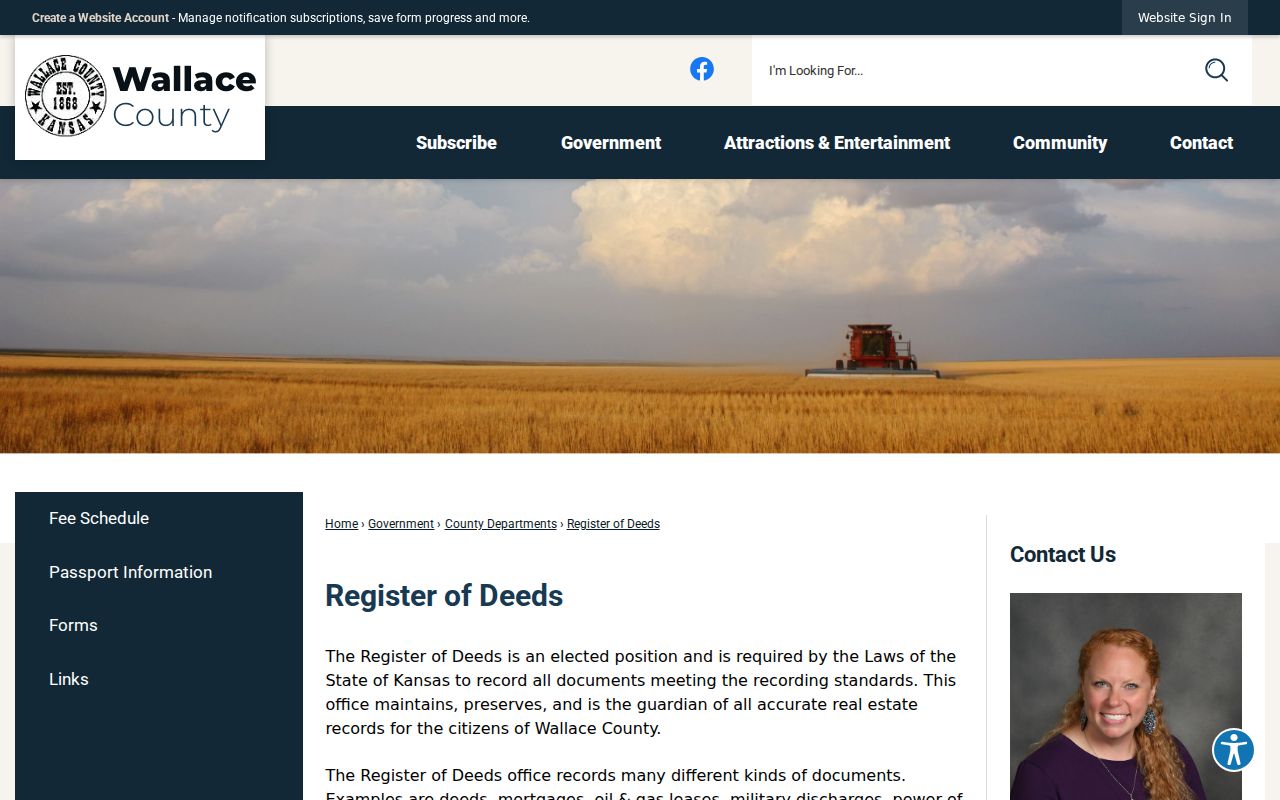
The Register of Deeds page lays out the office-centered path: staff contacts, named instrument types, and the free fraud-alert option. It offers no public online deed-index search.
Recorded, not guaranteed. Wallace County deed records show instruments accepted for recording, not a legal opinion that title is clear; unrecorded interests and unresolved defects may exist.
Read the Entire Instrument Trail
A Wallace County deed search should not stop at the grantor and grantee line. Pull the whole recorded instrument. Compare the legal description, return address, reservation language, signatures, acknowledgments, and references to earlier documents. An index entry exists for retrieval. It may compress the terms that matter. Acreage, lot numbers, or a mineral reservation can differ from the expected description. Preserve any discrepancy. Then search corrections, affidavits, and later deeds. Encumbrance research runs alongside ownership research. Search mortgages, assignments, releases, mechanic's liens, federal tax liens, judgments, lis pendens, easements, and oil-and-gas leases under the owner names and tract description. A release filed under a lender or agency name may not surface in a deed-only request. Court cases explain odd conveyances too. Foreclosure, partition, quiet title, and probate all leave traces; the Kansas courts public access portal and the courthouse terminal open the case route, subject to Rule 22 limits. Entities need special care as grantees. Preserve the exact legal name. The Kansas Secretary of State business database searches by name or Kansas business ID and can clarify entity identity. It still does not prove which real estate the entity owns; the deed and its legal description remain the only link to a Wallace County tract.