
Follow the Wallace County Property Records Trail
Wallace County publishes no online deed index, no assessor-card search, and no live parcel viewer. That makes an office-centered sequence the practical route. Start with what you already know. Keep owner names and addresses spelled exactly as recorded. Ask for an existing record rather than a new compiled report.
Each office answers a different piece of the question. An assessor record supplies the parcel key and valuation context. A recorded instrument proves a conveyance or encumbrance. The Treasurer answers tax-account questions, while GIS adds reference geography. A court case may explain a disputed or judicial transfer. None of these stands alone as a title opinion or survey.
- Give the Appraiser an address, owner variant, requested tax year, and any parcel or legal-description clue.
- Carry the parcel number and complete legal description into a Register of Deeds request.
- Ask the County Clerk to cross-check transfers, estate entries, corrections, tax-roll links, or severed minerals.
- Use Treasurer records for statements, payments, delinquency publications, and distribution details.
- Compare ORKA, the recorded plat, and court filings where geography or title litigation matters.
The Offices Behind Wallace County Property Records
The core offices share the courthouse at 313 N Main in Sharon Springs. Hours run Monday through Friday, 8 a.m. to noon and 1 p.m. to 5 p.m. Call ahead before any trip. The Register of Deeds records instruments. The Appraiser maintains parcel and valuation data. The Treasurer collects taxes. The County Clerk and District Court round out the picture with cross-checks.
Wallace County Register of Deeds
313 N Main
Sharon Springs, KS 67758
785-995-4281 ext. 330
Wallace County Appraiser
313 N Main, PO Box 31
Sharon Springs, KS 67758
785-995-4281 ext. 320
Wallace County Treasurer
313 N Main
Sharon Springs, KS 67758
785-995-4281 ext. 380
What to Request From the Wallace Appraiser
Wallace County's Appraiser sets values for real and personal property every January 1. The office studies sales and local economic conditions each year. It reinspects real property on a six-year cycle. Right now the office is working through a countywide building-condition review while preparing 2026 values. That makes it a smart stop for current valuation questions.
When you call or visit, be specific. Request the owner of record, plus both the situs address and the mailing address. Ask for the parcel or account identifier and the full legal description too. You can also ask for land and improvement values. Request total market and assessed values, class, acreage, exemptions, a building sketch with characteristics, year built, condition, the sale reference, and appeal status.
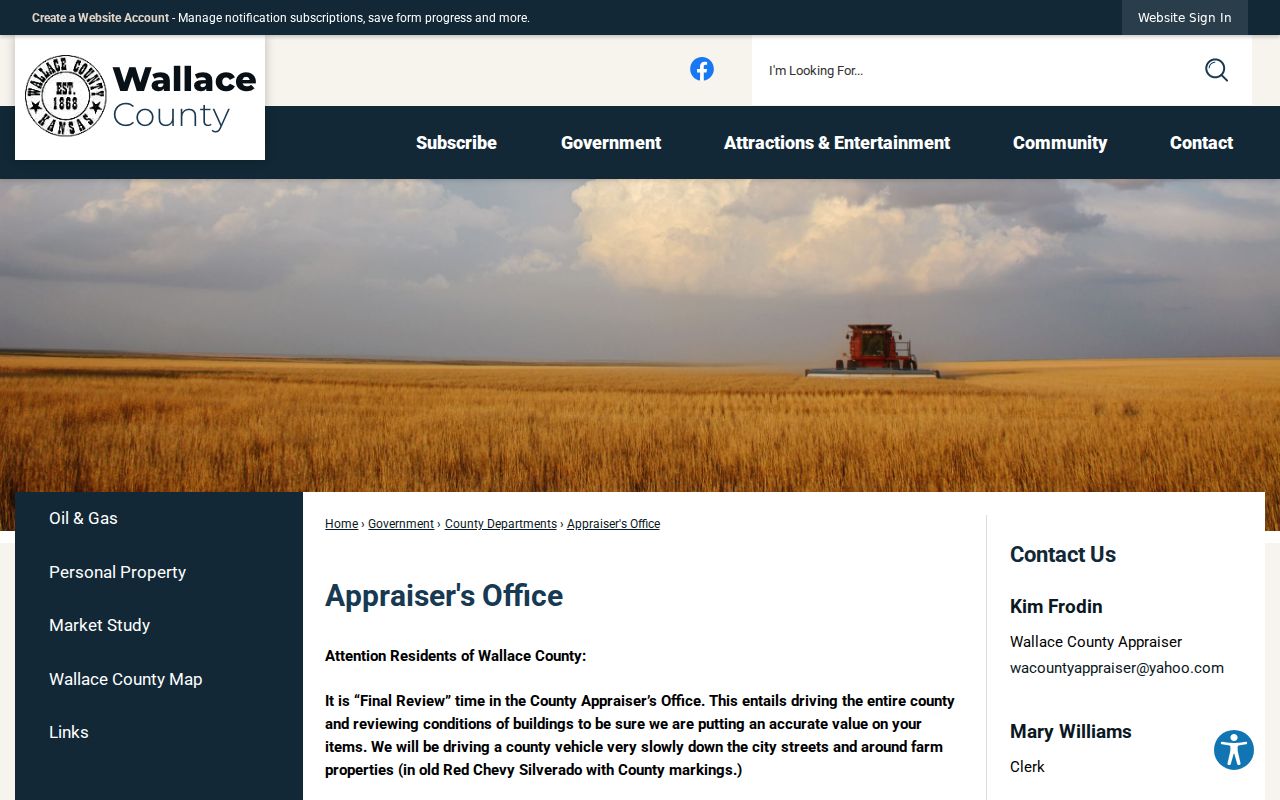
The county's official Appraiser page shows the office route. Wallace County offers no online parcel search for these details. The appraiser's staff handles requests directly.
No sample parcel card appears on the county site. Treat the list above as requested fields, not exact labels from a Wallace web result. A mailing address may point to an agent, trust, entity, or post-office box. It does not prove occupancy.
Recorded Deeds Require a Direct Office Search
The Register of Deeds records deeds, mortgages, oil and gas leases, powers of attorney, cemetery deeds, affidavits, and other instruments. All of these must meet Kansas standards. The office publishes no grantor, grantee, document-type, parcel, or date controls online. It states no earliest year for a web index. So request a search by grantor and grantee name variants. Add the legal description, instrument type, and date range. Ask for the instrument number or book and page. Also request recording date, parties, legal description, return address, prior references, and image or certification availability.
The live county office page carries the current email, staff, and telephone route. Records stay open during business hours under KORA. Statutory exclusions include Sales Validation Questionnaires and military discharges.
Match Wallace County Records to the Question
Pick the record set by what it legally documents. That habit keeps a tax mailing field from standing in as title proof, or a map line from passing as a surveyed boundary.
| Record Type | What It Documents | Kept By | Access |
|---|---|---|---|
| Deeds and affidavits | Recorded conveyances and title-related statements | Register of Deeds | Office inspection or KORA request |
| Mortgages, liens, easements | Recorded burdens, releases, and rights | Register of Deeds; court where litigated | Party and legal-description request |
| Assessment and tax | Parcel values, class, tax account, delinquency | Appraiser, Treasurer, Clerk | Office request, publications, statement payment |
| Plats and map layers | Lot-block descriptions and reference geography | Register of Deeds, Clerk, ORKA | Recorded plat request and GIS metadata |
| Permits and municipal actions | Approved work, moving permits, council action | City or County Clerk and Road & Bridge | Custodian request; Sharon Springs submissions portal |
Turn to Wallace County deed records for the recorded chain. Use the property tax records guide for assessment and tax detail, and the parcel-map guide for boundary context. Court dockets add foreclosure, quiet title, partition, judgment, and probate events, but the resulting recorded instrument still settles the record.
The County Clerk Bridges Transfers, Taxes, and Minerals
The County Clerk's duties span several property functions. The Clerk receives deeds, prepares certification, and records transfers in the transfer book. The office also updates real-estate and tax-roll programs, enters estate court documents involving real estate, and maintains severed minerals. That mix makes the Clerk a valuable cross-check when a deed chain, probate transfer, mineral reservation, or tax record will not line up.
Reach the Clerk at 785-995-4281 ext. 300 or wacoclk@fairpoint.net. Ask for a defined transfer, correction, tax year, estate entry, or mineral record. Leave general title conclusions out of the request.
Wallace Tax Publications Differ From Payment
The Treasurer collects and distributes property taxes. The office also publishes tax levies, delinquent real-estate and personal-property items, and quarterly reports. The publication archive holds confirmed delinquency material from 2020 through 2025. It also carries reports through April 2026. Those lists differ from the Kansas payment interface. That interface requires a tax statement and county selection rather than an owner-name roll search.
Ask the Treasurer for the parcel's statement, payment status, delinquency, distribution, or redemption information. Never turn a countywide report balance into a parcel-level tax amount.
ORKA Layers Offer Context With Clear Limits
The Kansas ORKA entry and KGS REST service identify address points, Wallace subdivisions, lots, plat blocks, roads, city limits, and county boundaries. The service answers JSON, geoJSON, and PBF queries. It reports a maximum of 2,000 records. Wallace County offers no live parcel search, owner card, adjacency tool, measurement control, or imagery date through this route.
Use the ORKA gateway and the official layer service as mapping routes. Then match the parcel to its recorded legal description. The county static map gives only broad geography. GIS lines remain reference and tax-mapping information, never a legal survey.
Assessment Value and Sale Price Are Separate
Kansas applies an 11.5 percent assessment ratio to residential property. Agricultural land sits at 30 percent under productivity rules. Commercial and industrial real property, along with agricultural improvements, carry 25 percent. Other classes follow their statutory ratios. These ratios convert an appraisal into assessed value. They never announce the sale price. Kansas collects transaction details on a Sales Validation Questionnaire. It records the price, date, financing, and any unusual circumstances. But state law keeps that form unrecorded and restricted from public view. The office retains it for five years and then destroys it. So it is not a public deed attachment. No sale price should be invented when the deed or parcel record does not show one.
Two Incorporated Cities Share the County System
Census 2020 counts two incorporated cities in Wallace County. Sharon Springs holds 751 residents. Wallace has 41. Weskan is a census-designated place rather than a third incorporated city, so its property records run through the same county system. Sharon Springs serves as the county seat and maintains a city office with a FrontDesk submission service. The city of Wallace publishes no municipal portal. For ownership, appraisal, and tax records in either city, the county custodians remain the source, and the city-specific guides cover permit, ZIP, historic-plat, and jurisdiction details without inventing offices or subdivisions.
The 1908 Atlas Extends the Historic Search
The 1908 Standard Atlas of Wallace County contains 42 images. Township landowners, town plats, a patrons' directory, and portraits fill its plates. The atlas can turn an old family or place reference into a section-township-range or lot-block clue. That clue can anchor a modern office request. Current addresses sometimes fail on old land. Federal tract books extend that route. Kansas Historical Society microfilm covers older material as well. Compare the mapped place with recorded deeds and modern parcel geography. Railroad-era names like Monotony or Weskan often surface in older sources. Treat the atlas as history rather than current title.
Free Fraud Monitoring Does Not Stop a Filing
The Register of Deeds offers Property Fraud Alert. This free service watches for filings that match a name you choose. Notifications arrive by email, text, or telephone. Distinctive spellings and entity variations benefit most. Prompt awareness is the whole point. The service does not block a document, verify signatures, prevent fraud, or replace periodic review of the record. Respond to any alert by calling the Register of Deeds through independently verified county details, and treat a caller or mailer demanding payment for a public deed as a red flag.
Court Records Explain Disputed and Judicial Transfers
The District Court sits in Kansas's 15th Judicial District. Foreclosure, quiet title, partition, probate, lis pendens, and judgment enforcement matters all land there. Court rules seal some files. The statewide Kansas court portal handles searches. The courthouse public terminal works too. The court publishes no Wallace-specific result screen, so a known party and case type is the best starting query. Ask the clerk for the docket and any public filing that describes the tract. Record the case number and filing date. Keep the parties, legal description, docket events, disposition, and document availability with your notes. A judgment or probate order can explain a transfer. Follow the resulting deed, sheriff's document, executor instrument, or affidavit into the Register of Deeds record, and call District Court at 785-995-4289 about copy and certification charges.
KORA Supports Every Offline Wallace Request
The Kansas Open Records Act, K.S.A. 45-215 through 45-223, governs access to public records. Its exceptions are specific. Inspection generally happens during regular business hours. An agency may demand a written request. It can also require identifying information, authorized fees, or advance payment before releasing anything. Narrow requests win. Describe the record, date range, owner variants, instrument type, parcel number, and legal description as precisely as you can. The Register of Deeds request form is simple. It takes requester and contact details, a description of what you need, and delivery choices for email, USPS, fax, or pickup. The form also carries a commercial-use certification. Phone and in-person contact remain open channels, Kansas Historical Society microfilm and interlibrary loan cover older material, and if an office denies or redacts a record, ask it to name the controlling exception.
Limits of Wallace County Property Records
Official records answer many questions. They cannot do everything. An owner of record, transfers, encumbrances, legal descriptions, assessed values, tax events, plats, and court actions appear, but occupancy, clear title, surveyed boundaries, sale value, and unrecorded interests lie outside a record's reach. Safe at Home can shield eligible victims. Military discharges, Sales Validation Questionnaires, and vital records carry special restrictions.
Lawful use. Kansas property records support purchase diligence, estate work, boundary research, assessment review, and civic transparency. K.S.A. 45-230 restricts commercial solicitation from public-record name and address lists. Never use record information to stalk, harass, intimidate, or harm anyone.